
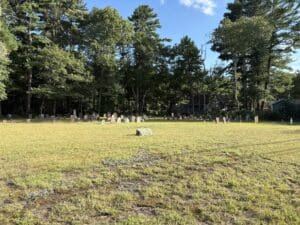
Located a couple hundred yards down from Route 105 on County Road and opposite the Methodist Church is the Old North Cemetery, a Quaker burial ground, though you may not be able to tell at a first glance, as all 326 graves are unmarked!
- When did Quakers Arrive in Massachusetts?
The first Quakers (or members of the Religious Society of Friends) arrived on the North American continent on July 11th, 1656. Two women, by the names of Ann Austin and Mary Fisher, stepped off of the ship Swallow and onto the cobbles of the Boston streets. However, Quakers beliefs are strongly antithetical to the dominant colonist religion in our area at the time, Puritanism. The two organizations were often at odds over things like the ultimate authority of the Bible, paid clergy, and outward sacrament, which the Quakers saw as corrupt. Consequently, the two women were almost instantly imprisoned, had their belongings confiscated, and deported five weeks later. However, the next year, more Quakers would arrive, some would be executed, some exiled. The more that were punished, the more Quakers that would arrive to protest the unfair laws. Eventually, in 1661, King Charles II issued an order to end executions, and a gradual decline in persecution followed in kind. Nowadays, there are many Quaker meetings places throughout Massachusetts and the country as a whole, such as our very own Quaker Meeting house in Mattapoisett.
- Are there still Quakers in Modern Marion?
Nowadays, the main place of worship for Marion and Mattapoiset Quakers is located at Mattapoisett Friends Meeting on 103 Marion Rd. on Route 6. The Quaker Burial Ground stands opposite the local Methodist church at 13 County Rd.
A 1956 quitclaim deed conveyed the burial ground to the Town of Marion with the permission of the members of the New Bedford Monthly Meeting of the Religious Society of Friends. The deed revealed that the plot of land (200 x 67 ft) was home to 326 unmarked graves.

- Why unmarked graves?:
The answer to this question is initially rooted in an interesting belief that a fair number of religions held in the 16-1800s, which was the idea that they were living in the era of the second coming of Jesus Christ, subsequently, religions such as the Quakers felt that they didn’t have time to worry about what comes after death, as 1.) They wouldn’t be dying anytime soon, as death will soon be a non-issue for the faithful, and 2.) They needed to focus on the here and now, beautifying God’s kingdom on earth. In short, they didn’t have time to worry about the afterlife when the here-and-now was in front of them.
When the new centuries came and went (without the messiah), those plans were put on the backburner for the time being. However, this would greatly influence the Quaker views on the afterlife in general. Quakers continued on with the dogma that a good, modest life is their primary expression of faith. As such, very little emphasis is placed on death in their religion. In line with this trend, Quakers do not often mark their graves, some claiming that headstones themselves are too worldly. In one example, an 1888 stipulation forbade a gravestone to be more than six inches above the soil.

____________
This blog post was written by Will Fortier, 2026 Rosbe Education Fund Intern.